Dashboarding Still Matters in 2026, But the Goal Has Changed

Home 2026 Topic 9 Why the future of dashboards is trust, context, and easier decision-making SEO focus: dashboarding 2026, business intelligence, trusted dashboards, AI-ready dashboards, Power BI, Tableau Dashboarding is still relevant in 2026, but expectations have changed. Learn how trusted, contextual, AI-ready dashboards outperform static reporting. Relevant dashboards still matter, but users expect context and easier interaction AI-ready BI now includes natural language, narrative, and guided insight Trust remains the deciding factor in whether leaders use dashboards at all Why this matters now Dashboards are not disappearing. They are being judged differently. In 2026, the question is no longer whether an organization has dashboards. The question is whether those dashboards are trusted, contextual, and usable enough to support decisions in an AI-enabled environment. Gartner’s analytics coverage points toward natural-language query, ML-discovered insights, and richer contextual intelligence inside ABI platforms. Salesforce research also highlights persistent trust gaps and strong demand for more intuitive ways to ask and answer business questions. Together, these trends suggest that dashboarding still matters, but the winning version is not static reporting. It is governed, contextual, and action-oriented. What organizations should do next 1 2 3 4 5 Prioritize Govern Connect Monitor Scale AI What modern dashboarding means Modern dashboarding blends clear KPI design with semantic consistency, narrative context, exception highlighting, and easier user interaction. It also connects reporting to the next step, whether that is investigation, workflow action, or AI-assisted exploration. Why many dashboards still fail The root problems are familiar: too many charts, weak business definitions, inconsistent filters, poor performance, and no clear audience. These issues make trust fragile. When trust drops, adoption drops with it. What to improve first The best upgrades are usually foundational. Standardize KPI logic, remove redundant content, restructure around decisions, improve performance, and add guided narrative or natural-language layers where they create real value. KPIs that add value KPI Why it matters Dashboard adoption rate Percent of intended users engaging with dashboards monthly Trust in metrics Survey-based confidence in dashboard numbers Performance SLA attainment Percent of critical dashboards meeting load-time targets Content redundancy Number of duplicate or low-value dashboards retired Decision support score User rating of whether the dashboard helps drive action Self-service success rate Percent of users able to answer common questions without analyst help How Thinklytics can help Dashboard audit and rationalization Executive and operational dashboard redesign Metric certification and semantic consistency Power BI and Tableau performance tuning Natural-language and narrative layer enablement If your team has plenty of dashboards but limited trust and adoption, Thinklytics can help you modernize reporting around clarity, consistency, and action. Book a Strategy Call
Production AI Requires Cost, Accuracy, and ROI Discipline

Home 2026 Topic 8 Why the next wave of AI work is less about demos and more about economics SEO focus: production AI, AI ROI, AI cost management, AI debt, enterprise AI strategy, analytics consulting The 2026 AI conversation is moving from pilots to production. Learn how to evaluate cost, accuracy, and ROI discipline before scaling enterprise AI. Targeted high-value use cases are outperforming broad AI-foreverything programs AI debt rises when teams scale models without strong data and governance ROI depends on measurable business outcomes, not launch volume Why this matters now By 2026, the AI conversation has matured. Executives are asking harder questions about cost, reliability, adoption, and business value. That is healthy. Production AI is not a slideware exercise. It is an operating model that must justify itself through measurable outcomes and controlled risk. Gartner’s 2026 predictions emphasize cost, accuracy, and AI debt. The broader message is that organizations should stop treating AI as a blanket mandate and instead prioritize targeted, high-value use cases with clear economic and operational metrics. This is the same discipline good analytics programs have always required, but the spending and risk exposure are now larger. What organizations should do next 1 2 3 4 5 Prioritize Govern Connect Monitor Scale AI What changes in production In a pilot, rough edges are tolerated. In production, latency, error handling, governance, fallback logic, monitoring, and cost-per-use all matter. A use case that looks exciting in a demo can become expensive or Thinklytics Page 2 brittle once integrated into real operations. The discipline leaders need Strong teams define use cases with baseline metrics, expected uplift, acceptable error thresholds, and a clear owner. They also measure downstream outcomes such as cycle-time reduction, conversion improvement, margin protection, or support deflection instead of celebrating usage alone How to prioritize Choose workflows where data quality is manageable, the business value is easy to measure, and the human review path is clear. Start narrow, prove value, and expand from there. KPIs that add value KPI Why it matters Cost per successful outcome AI operating cost divided by completed business outcomes Accuracy against benchmark Percent accuracy versus a human-reviewed or certified benchmark ROI payback period Time required for benefits to exceed implementation and run cost Adoption in target workflow Share of eligible users or transactions using the AI workflow Fallback rate Percent of interactions requiring non-AI backup handling Business impact Measured uplift in cycle time, revenue, margin, or service efficiency How Thinklytics can help AI use-case prioritization and ROI modeling Data readiness and accuracy benchmarking Pilot-to-production operating model design Governance, monitoring, and reporting for AI initiatives BI instrumentation to prove business impact If your AI roadmap is full of ideas but thin on economics, Thinklytics can help you prioritize use cases that have measurable value and production discipline. Book a Strategy Call
Agentic AI Needs Better Data Than Most Companies Have Today

Home 2026 Topic 7 Why autonomous agents rise or fail on the quality of the data layer beneath SEO focus: agentic AI, AI agents, data readiness, AI governance, enterprise AI, trusted data Agentic AI is a major 2026 topic, but most organizations are not ready. Learn the data foundations agents need and which KPIs matter before deployment. Agentic AI is now a major theme across data and analytics leadership conversations Grounded agents require trusted, governed, connected data Risk rises quickly when agents act on inconsistent business logic Why this matters now Agentic AI is one of the most discussed enterprise topics in 2026, but the real question is not whether agents are interesting. It is whether the data layer underneath them is ready. Agents can summarize, reason, route, recommend, and even trigger actions. That makes data reliability, governance, and semantic consistency much more important than in a read-only dashboard environment. Gartner’s 2026 summit themes explicitly include agentic AI, and Salesforce continues to frame the agentic enterprise as dependent on strong data foundations, trust, and security. The lesson for business leaders is clear: the path to useful agents starts in data management, not in prompt engineering alone. What organizations should do next 1 2 3 4 5 Prioritize Govern Connect Monitor Scale AI Why agents amplify data problems A static dashboard with a flawed metric can confuse a meeting. An agent connected to the same flawed logic can trigger outreach, prioritize the wrong accounts, or generate inconsistent recommendations at scale. Agents Thinklytics Page 2 multiply both value and error. The readiness checklist Before deploying agents, organizations should confirm identity and access controls, certified metrics, connected source systems, response logging, human review rules, and clear boundaries on what an agent may recommend versus execute. Where early value shows up The best near-term uses often involve grounded summarization, guided recommendations, and workflow orchestration around trusted data domains. This creates value without overexposing the business to unsupervised autonomous decisions. KPIs that add value KPI Why it matters Grounded response rate Percent of agent responses traceable to governed enterprise data Escalation rate Percent of agent interactions requiring human intervention Recommendation accuracy Accuracy of agent recommendations against expected outcomes Auditability coverage Percent of agent actions with logs, source references, and approvals Execution safety incidents Count of incorrect or unauthorized agent-triggered actions Time saved per workflow Labor hours reduced in targeted workflows How Thinklytics can help Agentic AI data-readiness assessment Governance and guardrail design for agent workflows Semantic grounding and trusted retrieval setup Pilot design for low-risk, high-value AI agent use cases Analytics architecture support for AI-enabled decision workflows If your leadership team is asking about agents, Thinklytics can help you assess whether your data foundation is ready before you automate risk. Book a Strategy Call
From Dashboards to Data Stories: Why Action-Oriented Analytics Wins in 2026
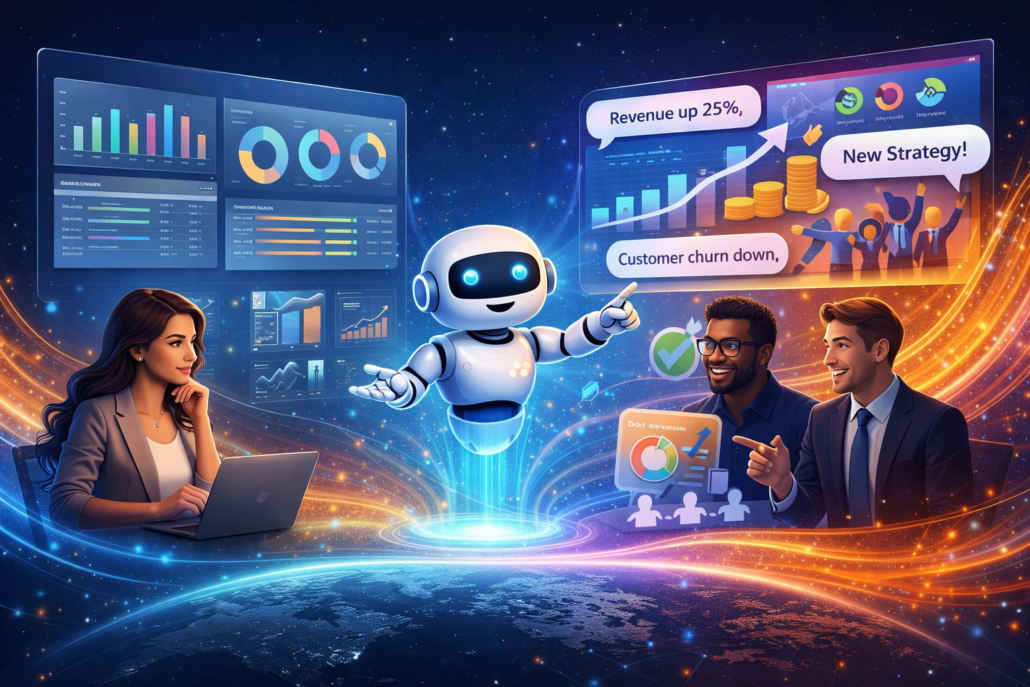
Home 2026 Topic 6 Why reporting now has to explain, prioritize, and point to decisions SEO focus: data storytelling, action-oriented analytics, dashboards, contextual intelligence, BI adoption, analytics strategy Static dashboards are no longer enough. Learn how action-oriented analytics and data storytelling are reshaping business intelligence in 2026. 75% of new analytics content is expected to be contextualized through GenAI by 2027 Context is becoming the bridge between insight and action Adoption improves when analytics shows what changed, why, and what to do next Why this matters now Dashboards are still useful, but the standard has changed. In 2026, leaders want analytics that do more than visualize. They want context, explanation, prioritization, and guidance. That is why the conversation has shifted from more dashboards to better data stories and action-oriented analytics. Gartner predicts that by 2027, 75% of new analytics content will be contextualized for intelligent applications through GenAI. That points to a broader change already visible in 2026: analytics should connect signals to decisions. When reports explain what changed, why it matters, and which actions are recommended, adoption and execution improve. What organizations should do next 1 2 3 4 5 Prioritize Govern Connect Monitor Scale AI Why static dashboards underperform A dashboard can show a red number without explaining whether the issue is seasonal, isolated, urgent, or likely to repeat. Users then leave the dashboard to ask for context in meetings, messages, or side analyses. The result Thinklytics Page 2 is delay. What data storytelling adds Strong data storytelling layers narrative on top of trustworthy metrics. It highlights the drivers, explains the business significance, and organizes the analysis around a decision. In modern workflows, this can include AI-generated summaries, but the summary still needs governed data and human-approved logic. How to build action-oriented content Start by identifying the decisions each report is supposed to support. Then restructure analytics around exception detection, comparison, driver analysis, and recommended actions. This usually leads to fewer charts and more business value. KPIs that add value KPI Why it matters Decision cycle time Time from issue detection to agreed business action Insight-to-action rate Percent of report views that lead to a follow-up workflow or decision Executive engagement Repeat usage of critical leadership reports Narrative clarity score User rating of whether reports explain what changed and why Exception resolution rate Percent of flagged issues resolved within target time Dashboard reduction Decrease in redundant reports after storytelling redesign How Thinklytics can help Executive dashboard redesign around decisions and actions KPI narrative layer and contextual insight design AI-assisted summary design with governance guardrails Report rationalization and content strategy Power BI and Tableau modernization for adoption If your dashboards are getting viewed but not driving decisions, Thinklytics can help you redesign analytics around context, narrative, and action. Book a Strategy Call
Natural-Language Analytics and Conversational BI: The New Access Layer for Data

Home 2026 Topic 5 Why leaders want to talk to data, not translate questions into SQL-like req SEO focus: natural language analytics, conversational BI, conversational analytics, agentic analytics, self-service BI Natural-language analytics is changing how people consume data in 2026. Learn what conversational BI actually requires and which KPIs prove adoption. 93% of business leaders say they would perform better if they could ask data questions in 63% of data leaders say translating business questions into technical queries is Conversational interfaces are becoming a major self-service channel for analytics Why this matters now Natural-language analytics is one of the clearest user-experience shifts in 2026. The promise is simple: people should be able to ask business questions in plain language and get fast, understandable answers. But conversational BI only works when the data underneath is governed, connected, and semantically consistent. Salesforce reports that 93% of business leaders believe they would perform better if they could ask data questions with natural language, while 63% of data and analytics leaders say translating business questions into technical queries is prone to error. This is not just a tooling trend. It is a signal that analytics must become more usable for nontechnical teams. What organizations should do next 1 2 3 4 5 Prioritize Govern Connect Monitor Scale AI What conversational BI is and is not Conversational BI is not simply putting a chatbot on top of a data warehouse. It requires access controls, business definitions, trusted data, and response patterns that distinguish between factual metrics, narrative Thinklytics Page 2 explanation, and recommended next actions. The adoption upside Natural language lowers the barrier to entry for managers and frontline teams who rarely open dashboards or build filters correctly. It also reduces dependency on analysts for routine business questions, which frees analysts to focus on deeper work. The implementation trap Many pilots fail because they are launched before the data foundation is ready. If source systems conflict or metric definitions are unclear, a conversational layer will expose the problem faster. The right sequence is unify, govern, define, then enable natural-language access. KPIs that add value KPI Why it matters Question success rate Percent of natural-language queries that return a correct usable answer Self-service adoption Monthly active users of conversational analytics tools Analyst deflection Reduction in ad hoc data request volume Time to answer Median time from question to trusted response User satisfaction Surveyed usefulness of conversational analytics responses Business action rate Percent of sessions leading to a follow-on decision or workflow How Thinklytics can help Conversational analytics readiness assessment Semantic and governance setup for natural-language querying Power BI and Tableau self-service optimization Prompt and response design for business users Adoption, training, and KPI tracking for conversational BI If your leaders want answers faster but your team is buried in ad hoc reporting, Thinklytics can help you build the governed foundation for conversational analytics. Book a Strategy Call
Semantic Layers and Business Context: The AI Foundation Most Teams Skip

Home 2026 Topic 4 Why consistent business meaning matters as much as pipelines and models SEO focus: semantic layer, business context, metric definitions, AI-ready data, semantic model, governed metrics Semantic layers are becoming a nonnegotiable foundation for AI-ready data. Learn why business context matters and which KPIs show semantic maturity. 80% potential GenAI accuracy lift when organizations prioritize semantics in AI-ready data 60% potential cost reduction tied to semantics in AI-ready data Must-do Gartner says leaders should budget for semantic capabilities as a foundation Why this matters now Most AI and BI failures look technical on the surface, but many are semantic failures. Teams ask the same question in different tools and get different answers because the business meaning of revenue, active customer, margin, inventory, or service level was never standardized. In 2026, semantic layers have become a core topic because AI needs context, not just raw tables. Gartner’s 2026 predictions explicitly call for budgeting semantic capabilities as a nonnegotiable foundation and say organizations that prioritize semantics in AI-ready data can improve model accuracy and lower cost. That makes semantic work one of the highest-leverage investments in analytics right now: it reduces inconsistency for humans and improves grounding for AI. What organizations should do next 1 2 3 4 5 Prioritize Govern Connect Monitor Scale AI What a semantic layer really does A semantic layer sits between raw data and consumption tools. It standardizes business definitions, relationships, calculations, and access logic so dashboards, self-service analysis, embedded analytics, and AI interfaces all work from the same meaning system. Why this matters for AI When AI accesses enterprise data without semantic controls, it can return technically correct but operationally wrong answers. A semantic layer helps ground prompts, enforce definitions, and reduce the chance that two teams automate against conflicting logic. Where to start Start with the handful of metrics leaders care about most. Document the logic, create governed definitions, align source mapping, and expose those definitions consistently across Tableau, Power BI, spreadsheets, and AI experiences. The goal is not theoretical perfection. It is decision consistency. KPIs that add value KPI Why it matters Certified metric coverage Percent of executive KPIs governed through a semantic layer Metric consistency rate Percent agreement of the same KPI across tools and teams AI answer accuracy Accuracy of AI-generated answers against certified business logic Reused semantic objects Count of reusable governed measures, dimensions, and definitions Time to onboard new reports Days to create new content using standardized semantics Analyst rework reduction Decrease in one-off KPI reconciliation work How Thinklytics can help Business glossary and metric-definition program Semantic model design for Power BI, Tableau, and AI use cases KPI certification, naming standards, and logic documentation Cross-tool consistency architecture AI grounding strategy for governed enterprise data If your teams keep getting different answers to the same business question, Thinklytics can help you build a semantic layer that standardizes meaning before AI scales inconsistency. Book a Strategy Call
Data Quality, Trust, and Metadata: The 2026 Control Layer for Analytics and AI
Home 2026 Topic 3 Why verification and metadata are now executive issues, not just engineerin SEO focus: data quality, metadata, active metadata, trusted data, data lineage, analytics trust Poor data quality still blocks analytics and AI. Explore why active metadata, verification, and trust controls matter more in 2026 and which KPIs to track. Trust gap Leaders increasingly question whether data is accurate enough for action Metadata is becoming essential for lineage, ownership, and AI context Verification matters more as AI-generated content enters the data flow Why this matters now Data quality has always mattered, but 2026 raises the stakes. The issue is no longer limited to inaccurate dashboards. Poor quality now creates weak model outputs, broken automations, and low confidence in decision-making. Metadata has become part of the answer because quality is hard to improve when nobody can see lineage, ownership, freshness, or business meaning. Gartner’s 2026 predictions and data architecture guidance put more emphasis on semantics, metadata, and context. Salesforce’s data studies also show that business leaders want easier access to trusted, understandable insights. The through-line is simple: quality is not just about fixing records. It is about making data observable, documented, and interpretable enough for both people and AI systems. What organizations should do next 1 2 3 4 5 Prioritize Govern Connect Monitor Scale AI Why quality fails in real organizations Many companies still manage quality reactively. A leader notices a wrong metric, the team backtracks through transformations, and the fix lives in a ticket or someone’s memory. Without metadata, the same issues return because root causes are not visible across sources, pipelines, and dashboards. What active metadata changes Active metadata connects technical lineage with business context. It helps teams see where a metric came from, who owns it, how often it refreshes, what changed upstream, and which reports or use cases will be affected by a change. That visibility reduces rework and shortens incident response. A practical trust model For 2026, teams should classify critical metrics, define allowable thresholds, publish owners, and monitor quality before numbers reach executives. They should also flag AI-generated annotations or derived content separately from system-of-record data so users know what is verified versus generated. KPIs that add value KPI Why it matters Data quality score Composite score across completeness, accuracy, timeliness, and consistency Freshness SLA attainment Percent of datasets meeting refresh expectations Lineage coverage Percent of critical metrics with documented source-to-report lineage Issue resolution time Average time to identify and fix priority data defects Metadata completeness Percent of priority assets with owner, definition, and refresh documentation Executive trust score Survey-based confidence in reported metrics How Thinklytics can help Data quality assessment and remediation plan Metric certification and KPI trust framework Metadata, lineage, and catalog design support Quality monitoring for dashboards and downstream AI workflows Governance processes for verified versus generated content If your team still spends more time debating numbers than acting on them, Thinklytics can help you build the metadata and quality controls that make trust repeatable. Book a Strategy Call
Unified Data in 2026: Why Integration Is Still the Bottleneck

Home 2026 Topic 2 Why app sprawl keeps blocking analytics, automation, and AI SEO focus: unified data, data integration, system integration, data silos, enterprise data, analytics architecture. Fragmented applications still hold enterprises back. Learn why unified data remains a top 2026 priority and which KPIs signal integration progress. 897 average enterprise applications 29% have established formal data governance frameworks and policies Unified data is now a prerequisite for usable AI and reliable reporting Why this matters now Most organizations do not have a dashboard problem first. They have a fragmented data problem. In 2026, unified data remains one of the biggest priorities because reporting, analytics, and AI break down when customer, finance, operations, and service data live in disconnected systems. Salesforce reports that the average enterprise uses 897 applications and only 29% are connected. That level of fragmentation creates conflicting metrics, duplicate records, manual exports, and slow decision cycles. It also raises the cost of every downstream initiative, from self-service BI to AI agents, because teams have to reconcile data before they can trust it. What organizations should do next 1 2 3 4 5 Prioritize Govern Connect Monitor Scale AI Why integration matters more now Traditional BI could survive some fragmentation because analysts could manually reconcile extracts. AI and real-time decision workflows are much less forgiving. They need connected data, shared definitions, and a Thinklytics Page 2 consistent way to retrieve context across systems. The business symptoms The warning signs are familiar: weekly spreadsheet merges, different revenue numbers in different tools, customer records that do not match across CRM and ERP, and teams waiting on custom data pulls before every leadership meeting. The cost is not only time. It is also missed action because nobody agrees on the starting numbers. How to modernize without boiling the ocean The best path is not to integrate everything at once. Start with the business workflows where inconsistency creates the most delay or risk. Build a priority model around a handful of high-value domains such as customer, order, revenue, product, and service. Then design reusable pipelines, shared identifiers, and governed semantic definitions that can support both BI and AI. KPIs that add value KPI Why it matters Source connectivity rate Percent of priority source systems integrated into the analytics layer Manual data preparation hours Hours per week spent on spreadsheets and one-off reconciliations Duplicate record rate Percent of duplicate entities across core systems Data latency Average time from source update to analytics availability Cross-system match rate Percent of records successfully linked across target systems Reporting cycle time Days required to produce recurring management reports How Thinklytics can help Integration roadmap and target-state architecture Data model design across CRM, ERP, finance, and operational systems Pipeline development and orchestration support Master data alignment and KPI standardization Tableau and Power BI data foundation optimization If your reporting still depends on exports, stitched spreadsheets, or conflicting source systems, Thinklytics can help you prioritize and build a unified data foundation. Book a Strategy Call
Data Governance and AI Governance in 2026: The New Foundation for Trusted AI

Home 2026 Topic 1 Why governance has moved from compliance task to AI operating requirement SEO focus: data governance, AI governance, zero trust data governance, trusted AI, data security, analytics consulting. Learn why data governance and AI governance are converging in 2026, what zero-trust governance means in practice, and which KPIs 88% of data and analytics leaders say Al demands new governance and security approaches 43% have established formal data governance frameworks and policies Zero-trust governance is gaining attention as Al-generated data expands Why this matters now The shift is straightforward: when more people and machines can generate, transform, or consume data, trust has to be engineered. Salesforce’s latest State of Data & Analytics research shows that most leaders believe AI requires new governance and security approaches, yet less than half say they have formal governance frameworks in place. Gartner has also pushed leaders toward stronger semantic and governance foundations as AI programs move from experimentation into enterprise workflows. The shift is straightforward: when more people and machines can generate, transform, or consume data, trust has to be engineered. Salesforce’s latest State of Data & Analytics research shows that most leaders believe AI requires new governance and security approaches, yet less than half say they have formal governance frameworks in place. Gartner has also pushed leaders toward stronger semantic and governance foundations as AI programs move from experimentation into enterprise workflows. What organizations should do next 1 2 3 4 5 Prioritize Govern Connect Monitor Scale AI What this looks like inside a business In practice, governance in 2026 is less about a binder of policies and more about operational controls. Teams need clear ownership for critical data products, role-based access, rules for sensitive data, documentation for business definitions, and approval paths for AI use cases. They also need a way to separate verified business data from AI-generated summaries, tags, or derived content so downstream teams know what is authoritative. What leaders get wrong A common mistake is believing governance slows down AI. Weak governance is usually what slows it down. Teams lose time in legal review, security review, exception handling, and remediation because the data estate is not organized for accountable reuse. Another mistake is leaving governance only with IT. In 2026, effective governance requires business ownership for KPIs, data domains, and the acceptable use of AI outputs. What good looks like The strongest programs are practical. They define a short list of business-critical domains, assign owners, standardize definitions, enforce access rules, and monitor usage. They also document where AI is allowed to automate, where human review is required, and which outputs can be used operationally versus informally. KPIs that add value KPI Why it matters Policy coverage Percent of critical data domains with approved governance policies Data owner assignment Percent of priority datasets with named business and technical owners Access exception rate Number of nonstandard data access requests per month Sensitive data exposure incidents Count and severity of governance or privacy violations AI output review rate Percent of high-risk AI outputs reviewed by a human Time to approve new data access Average business days from request to approved access How Thinklytics can help Governance operating model design for data and AI Role-based access and stewardship framework Business glossary, KPI definition, and semantic standardization Data lineage, documentation, and audit-readiness support Governed Power BI and Tableau deployment standards If your team is moving into AI without clear data ownership, controls, and definitions, Thinklytics can help you build a governance model that is usable, not bureaucratic. Book a Strategy Call